The Logo Swap Test: Why Content Nobody Can Attribute to You Compounds Into Nothing

Open your competitor's blog. Now open yours. Swap the logos. If a buyer can't tell who wrote what, you have a positioning problem dressed up as a content calendar. A company with a 40-person marketing department can blend in for a quarter and recover. A seed-stage founder publishing between sales calls and investor updates cannot.
That asymmetry points to the sharpest editorial filter available to lean B2B teams right now: if a content idea is easy to agree with, it's almost impossible to own. And content you can't own doesn't compound. It just accumulates.
The Agreeable Content Trap
Run this test on every piece in your calendar. Read the headline. If a reasonable person's first reaction is "yes, obviously," the piece has a positioning problem. "Positioning matters." "Customer research d rives better messaging." All true. All publishable by every competitor in your category without changing a word.
Founder-led teams fall into this pattern for defensible reasons. When you're stretched across product, sales, hiring, and fundraising, the instinct is to publish things that feel safe. But agreeable content forces you to compete on volume—the one dimension where a solo founder will always lose to a team with dedicated writers, editors, and a paid distribution budget. The better game is competing on what only you can credibly say. Founders close to the customer, the product, and the raw market signal have structural advantages over agencies and large marketing departments. Those advantages disappear the moment the content reads like it was written by someone who Googled the topic for 20 minutes.
Finding Whitespace Before the First Draft
Pull up the blogs and LinkedIn feeds of your three closest competitors. Read their last 15 posts each. Write down the recurring themes, the repeated arguments, the audiences they address. You're looking for what none of them are saying: the questions buyers ask that nobody in the category answers with any specificity.
Then pressure-test each gap. Do you have genuine expertise or proprietary insight? If not, you'll produce the same generic take from a slightly different angle. That's a costume change, not whitespace. Does this topic connect to a buying decision your prospects actually face? A gap that doesn't map to pipeline is a hobby.
This research step is where most founder-led content efforts stall. According to Content Marketing Institute's B2B research, only 47% of B2B marketers have a documented content strategy. Among those who do, 29% rate it as very or extremely effective. The gap between "we publish content" and "we publish content that works" is largely upstream: understanding what's already saturated before deciding what to write. Tools like Visibilio can compress that research by scanning your existing content for repetition and identifying where your point of view is underdeveloped. For a team of one or two, that turns a weekend of competitor reading into a faster editorial decision.
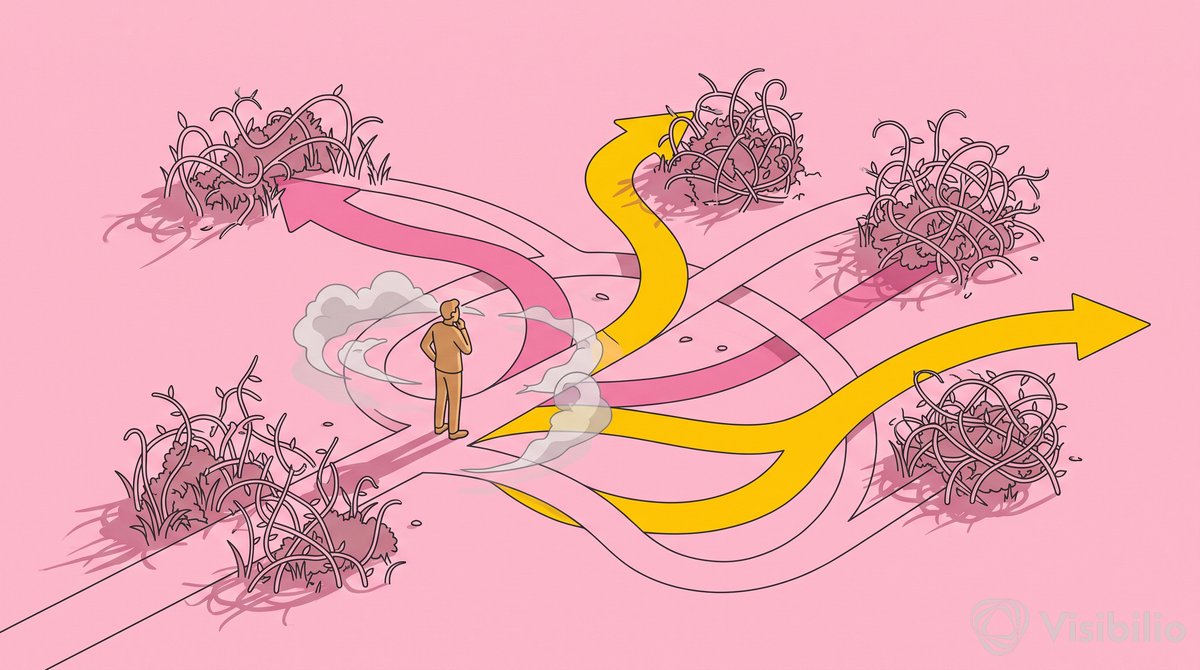
If a buyer can't tell who wrote what, you have a positioning problem dressed up as a content calendar
A Kill Rule for Summer
Summer is particularly dangerous for agreeable content. Engagement dips. Teams feel pressure to keep publishing. The temptation is to fill the calendar with safe, low-effort posts that maintain presence without requiring hard editorial choices.
Apply a kill rule before any piece moves to draft. Two questions, both binary. Could a competitor publish this under their logo without changing the core argument? If yes, kill it. Does this piece build toward a topic you want to own by Q4 2026? If no, kill it.
What survives tends to be sharper. A teardown of how procurement teams actually describe their problems. A framework for identifying which content topics your competitors have already saturated. An audit of your own library that flags everything a buyer couldn't attribute to you in a blind test. These pieces take longer to produce. They also do something agreeable content never does: they make a reader remember who wrote them.
One caveat. Consensus content isn't always worthless. A well-executed explainer on a topic buyers actively search for can drive traffic and build trust, even when competitors cover the same ground. The kill rule applies to positioning content. For pure SEO utility plays, the calculus is different. Know which game you're playing.
If that distinction isn't clear inside your team, make it explicit in the calendar itself. Label each piece by job: positioning, demand capture, customer education, sales enablement, or retention. Once the job is visible, the editorial standard gets easier to apply. A positioning piece should sound unmistakably like you. A search-driven explainer can be more conventional, as long as it's useful. Confusing those two goals is how teams end up publishing content that does neither job well.
What Does Ownable Content Actually Look Like?
Ownable content usually has at least one of four traits. It uses firsthand customer language your competitors haven't documented. It introduces a framework rooted in your operating experience. It challenges a category assumption with evidence from the field. Or it names a problem more precisely than the market currently does.
That doesn't mean every article needs a hot take. It means every article needs a reason to exist under your name. Sometimes that reason is a strong point of view. Sometimes it's access to patterns only your team sees. Sometimes it's the ability to connect product detail, buyer behavior, and sales friction in a way a generalist writer can't.
A useful test is to ask what the reader could repeat after finishing the piece. If the takeaway is a generic principle they already believed, the article probably won't travel. If the takeaway is a phrase, distinction, or framework they now associate with your company, you're closer to something that compounds.
How Do I Know If My Content Is Building a Distinct Point of View?
Killing agreeable content creates an uncomfortable gap. Fewer posts. More blank space. For founders already guilty about inconsistent publishing, that blankness looks like failure. It isn't.
B2B buyers consume three or more pieces of content before engaging sales in 67% of cases, according to multiple 2023 industry surveys. The question isn't whether you published this week. The question is whether the three pieces a buyer encounters create a distinct impression of your company or blur into the category background. Three strong, ownable articles do more for brand association than 30 posts that could have come from anyone.
Founders who build that discipline early create a compounding advantage. Every piece reinforces the next. Every angle builds on a documented point of view. The library becomes an asset a future marketing hire can inherit and extend, rather than a collection of orphaned posts.
One practical way to measure this is to review your last ten posts and ask what themes they reinforce together. Do they point toward a coherent belief about the market, the buyer, or the problem you solve? Or do they read like isolated attempts to stay active? A compounding calendar doesn't just publish good standalone pieces. It creates pattern recognition over time.
The Calendar That Compounds
The strongest founder-led content calendars are not full. They are directional. They trade frequency for recognizability. They revisit the same core tensions from different angles until the market starts to associate those ideas with the company behind them.
That requires restraint. Not every decent idea deserves publication. Not every keyword deserves a post. Not every internal subject-matter expert needs to be turned into a byline. The calendar compounds when each piece strengthens a territory you're trying to own, rather than scattering attention across whatever seems useful that week.
The logo swap test isn't a one-time exercise. Run it quarterly. If the answer keeps improving, the content is working. If it doesn't, more volume won't fix it. The problem was never how much you published. It was whether anyone could tell it was you.