Good Coffee Festival Gets a Full Publishing System for Its Next Edition
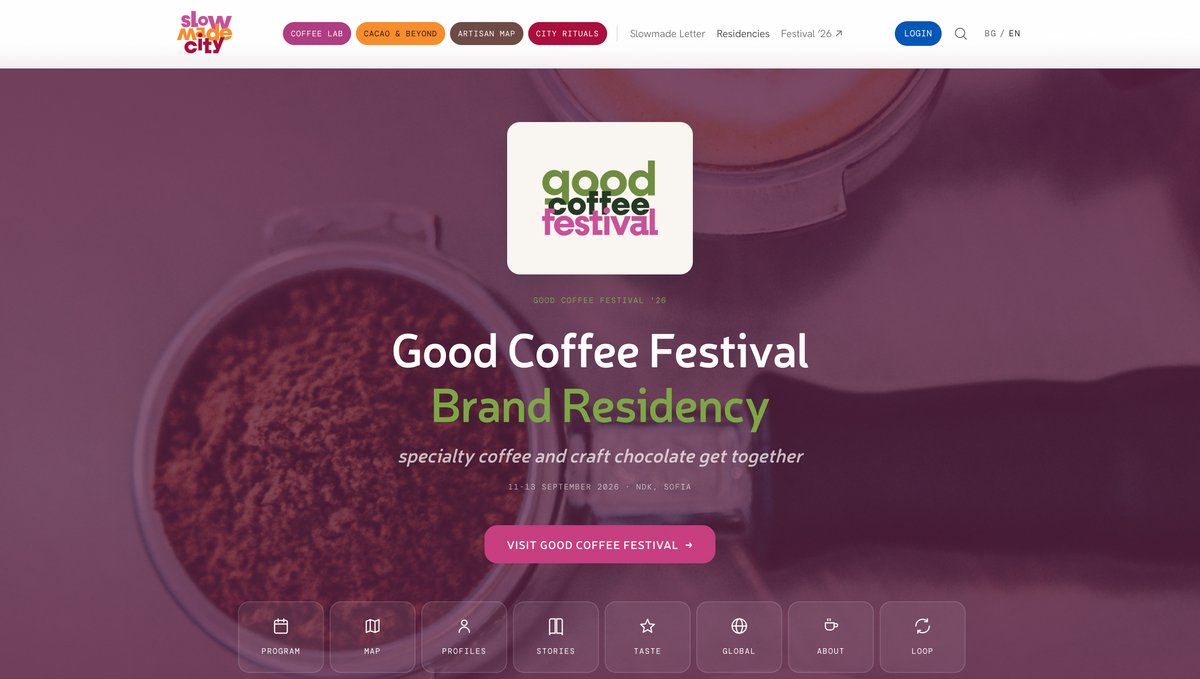
We're genuinely happy about this one. After the work we did for Good Coffee Festival's previous edition, the partnership continues, and the scope is growing. For the next April edition, we're taking on the festival's website design, build, and its reservation and payment system, alongside the content operation we already run.
That feels worth explaining, because the story of how we got here says something about what owned media can actually do for an event.
What Slow Made City Built (and Why It Wasn't Just a Promo Site)
For the festival's previous April edition, we created a standalone media property for the organizers: slowmadecity.com, a site dedicated to specialty coffee, cacao, and urban culture. The brief wasn't "make a landing page for the event." It was broader: build something that connects the coffee enthusiasts with the companies and roasters who made the festival possible.
That distinction matters. A landing page dies when the event ends. A media property keeps publishing. Slow Made City carried programme details (including a detailed hour-by-hour schedule for Good Coffee Festival, an outdoor event with free entry on the square in front of NDK in Sofia), but it also ran editorial content about the specialty coffee scene. The result was a small, genuine community forming around the site, not just a countdown to a date.

After the work we did for Good Coffee Festival's previous edition, the partnership continues, and the scope is growing
AI Visibility as a Side Effect of Good Publishing
The site was built to be readable by bots and AI agents from the start: clean structure, clear attribution, well-organized content. AI visibility, measured as bot visits and citations in AI-generated answers, grew organically over time, with a logical peak during the festival itself.
The pattern is consistent with what the broader market is seeing. HUMAN Security's 2026 benchmark report found that monthly AI-driven traffic grew 187% from January to December 2025, with AI agents and agentic browsers growing at an even steeper rate. A site built with clear, structured, well-attributed content is more likely to be crawled, parsed, and cited by these systems.
A caveat worth stating plainly: AI crawler visits and AI-generated citations are different things, and neither automatically translates into ticket sales, partner leads, or any specific business outcome. Search Engine Land and PromptMarketing both stress that AI visibility should be treated as sampling across a defined prompt set, not a stable ranking. We track mentions, citations, and framing separately, and we're careful not to conflate bot traffic with human referral traffic.
So we won't claim the site "dominated AI search." The publishing approach made the festival's information consistently available to AI systems, and the signals grew in a pattern that made sense given the event timeline.


What Changes for the Next Edition
For the upcoming April festival, the engagement expands beyond content. We're now responsible for:
- The festival website's design and build
- The reservation and payment system for seats (relevant for workshops and limited-capacity sessions rather than general admission, which remains free)
- The ongoing content operation through Slow Made City
This is the trajectory we think makes sense for events: content operation first, then the website and transactional layer as a coherent system, not three separate vendor relationships stitched together after the fact. One team holds the editorial standards, the information architecture, and the booking flow. Fewer handoffs, fewer inconsistencies.
A simple checklist for what an event's digital presence needs to do well:
- Publish accurate, structured content that humans and AI systems can read
- Build community between attendees and the brands involved, not just announce dates
- Handle reservations and payments without sending visitors to a disconnected third-party page
- Maintain a consistent voice across every touchpoint
When one team owns all four, the pieces actually fit.
Community Over Campaign
The part of this project we keep coming back to is the community layer. Slow Made City didn't just list sponsors and post a schedule. It told stories about the roasters, the cacao producers, the people behind the booths. That editorial work created a relationship between the audience and the festival's partners that outlasted the event weekend.
For organizers and brands reading this: the question isn't whether you need a website for your event. You do. The question is whether that site becomes a disposable campaign asset or a durable editorial property that keeps working between editions. We'd argue the second option is worth the effort, and the Good Coffee Festival partnership is where we're proving it out.
Sources
- Measuring the AI-Driven Internet with The 2026 State of AI Traffic & Cyberthreat Benchmark Report — humansecurity.com
- AI search visibility is sampling, not tracking - PromptMarketing — promptmarketing.com
- AI Bot & Agent Traffic Trends 2026 — datadome.co
- The 2026 State of AI Traffic & Cyberthreat Benchmark Report | HUMAN Security — humansecurity.com
- Bad bot traffic is growing 9 times faster than human web traffic — fastcompany.com
- Nearly two-thirds of tested websites fail every bot test — helpnetsecurity.com
- How to Track AI Search Traffic (ChatGPT, Perplexity, Claude — clickport.io
- In Graphic Detail: The state of AI referral traffic in 2025 — digiday.com
- AI vs Search Traffic Analysis — ahrefs.com
- Search engines still get 19x more web traffic than AI chatbots, new — technext24.com